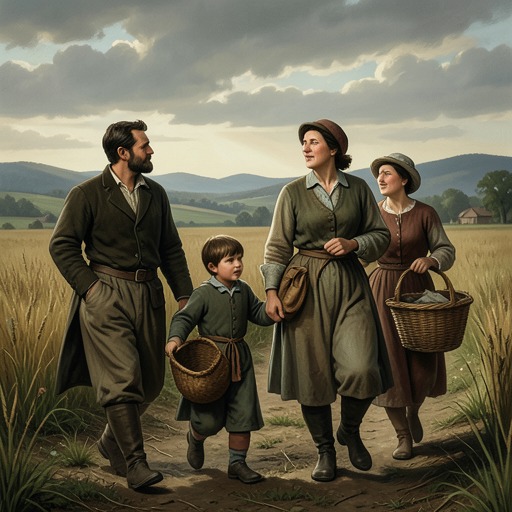
The decline of the fruit-picking industry
The Darling Buds of MayThe decline of the fruit-picking industry is an approaching economic crisis in the world of Pop Larkin: the seasonal harvest that gives the family work and income is being undermined by disease. The contrast is sharp. The fruit calendar once seems to offer one crop after another, but Pop predicts that strawberries, raspberries, plums, cherries, and apples are all nearing the end of their productive run. This change turns an apparently abundant rural routine into a precarious livelihood—and puts the Larkins’ informal economy in uneasy proximity to official tax records.
A livelihood organized by the seasons
The harvest begins as a sequence of opportunities rather than a single brief season. In spring, the truck passes strawberry fields in sunlight beneath orchard branches just beginning to flower; Pop notes that straw has been laid over the crop and estimates that it will be ready within days. He asks the children whether they want to pick. The question introduces strawberry work as a family activity, not merely scenery: the fields ahead are a source of labor and income, and the return of picking gives the household a practical calendar.
That calendar extends across the year. Strawberries are picked in June, followed by cherries before the month ends and more cherries through July. In a good summer, apples may begin before August, along with early plums and pears; apples continue in August and September, hops are harvested in September, and potatoes in October. The sequence makes the family’s rural economy depend on moving from one crop to the next. It also explains the stakes of decline: damage to one fruit threatens a livelihood structured around seasonal work, while disease across several crops threatens the succession itself.
The scale of the strawberry harvest is made concrete by its earning potential. With a large family, picking strawberries alone can bring in fifteen pounds a day. Later, at Benacre, Montgomery reports that picking will start on Monday, earlier than ever; Pop attributes the early crop to the weather, saying it has put the colour on the berries. These details initially suggest a season arriving ahead of schedule and a harvest ready to be gathered. Against that promise, Pop’s subsequent diagnosis of a failing industry carries more force: an early start does not mean a secure future.
Disease and the forecast of decline
The change comes into focus when Pop says that the strawberry season is nearly over. Mr Charlton, preoccupied with the tax form he is trying to remember, hears the remark as an interruption to his concentration; Pop, however, is describing a larger economic and agricultural problem. He names Sovereigns, Climax, and Huxleys as strawberry varieties that are finished, and warns that soon there will be no strawberries anywhere. His account is rooted in the specific varieties and the expected disappearance of the crop, rather than in a general complaint about a poor harvest.
Pop then widens the warning beyond strawberries. The cause he gives is disease, and the forecast is not confined to the local growing district: in two years, he says, the strawberry business will be over in every district. Raspberries, too, are nearly finished, affected by mosaic and a weakening strain. He adds the plum, cherry, and apple businesses to the list, observing that apples can scarcely be sold. The repeated movement from one crop to another turns what might have seemed a temporary bad season into a pattern of diminishing prospects across the fruit economy.
The contrast with the earlier harvest calendar is central to the significance of the decline. Strawberries, cherries, apples, plums, and pears had appeared as successive openings for work, with hops and potatoes extending the cycle into autumn. Now Pop names disease, weakened strains, and unsaleable apples as signs that those openings are closing. The novel does not supply an agricultural report or a separate account of the causes; it presents the outlook through Pop’s practical, emphatic assessment. His prediction is striking precisely because the harvest still occupies the family’s everyday plans even as he describes its future as disappearing.
Work, money, and official records
The fruit trade is not only a backdrop to family life; it is a substantial flow of labor and payment. On Mr Charlton’s first day in the strawberry field, the heat becomes punishing, and his physical discomfort leads him away from picking and into the weighing tent. There Pop introduces him to Mr Jennings, who needs someone to weigh and book the baskets. The temporary job places Mr Charlton at the point where the harvest becomes countable: baskets arrive, weights are checked, and the day’s produce passes through a record-keeping station.
From the tent, Mr Charlton calculates that he has checked in more than a ton of strawberries in one day. He infers that this represents a considerable amount for the pickers, then wonders about the tax position of their earnings. His concern grows from the same visible facts that make the harvest seem prosperous: a great volume of fruit and many people being paid for seasonal work. Later he tells Pop that substantial sums are paid out for strawberries, cherries, and hops, and that, strictly under the law, the seasonal workers ought to pay tax on that income. The episode brings the informal labor system face to face with the obligation to report income.
That issue echoes the tax inspector’s earlier finding that Pop had made no return of income for the preceding year. Pop professes not to know what return is meant and says nobody had asked him; the inspector produces a yellow-buff form as evidence of the procedure. The form recurs at the family table when Mr Charlton spreads it out and uncaps his fountain pen. Later, as Pop discusses the fruit trade, Mr Charlton struggles to keep the form in mind. The juxtaposition links agricultural earnings to official paperwork without making the work itself disappear into a tax dispute: the baskets, the pickers, and the money paid out are the material reality that the form is meant to register.
From picking to the egg business
The industry’s decline belongs to a wider pattern of Larkin enterprise rather than marking the end of the family’s capacity to make a living. After marrying Mariette, Mr Charlton leaves his job at the tax inspector’s office, a change Pop welcomes because he does not want anyone in the family connected with the tax business. Pop gives the couple five hundred laying pullets, setting them up in egg production. In less than a year, they have made enough profit to buy another five hundred hens.
The transition from fruit picking to eggs sharpens the tension between practical prosperity and formal accountability. Mr Charlton continues to make proper income-tax returns on the egg earnings, a habit Pop regards as a mistake. The household’s work thus moves into a new line of business, while the argument over how earnings should be recorded remains. The earlier harvest had already shown how seasonal labor could generate substantial payments; the later poultry venture demonstrates that income-producing activity persists beyond the fruit trade, even as Pop’s resistance to official returns persists alongside it.
The decline of the fruit-picking industry therefore carries both material and structural weight. It threatens a seasonal cycle that once promised successive crops and daily earnings, while exposing the distance between the Larkins’ understanding of work and the state’s demand that income be declared. The harvest is at once a landscape, a source of family labor, a stream of money, and a subject of taxation. As disease narrows the prospects for fruit, the novel keeps those layers in view: the fields may still be busy, but the livelihood they represent is no longer assured.